POLAR BEARGeothermal · Toronto 647-914-8114

Print / Save as PDF Four pages, Letter size. Prints clean — no navigation, no buttons.

Polar Bear GeothermalDesign–build · Total project engineering

We engineer the whole system, and we fit one brand of heat pump: the one built in Toronto.

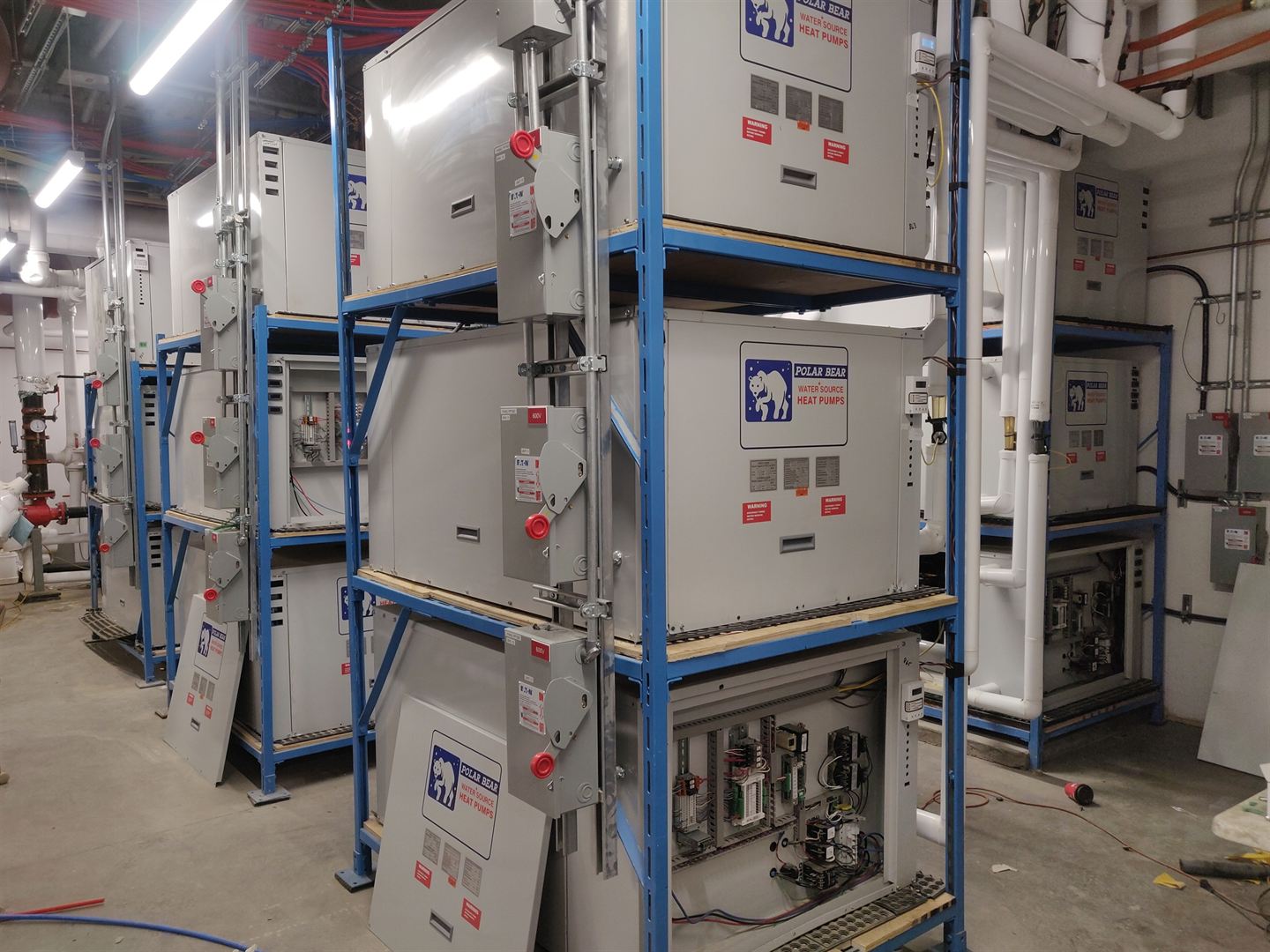
Geothermal jobs usually get assembled from strangers — a driller, a mechanical contractor, a consulting engineer, and an equipment brand shipped in from elsewhere. When something underperforms, each of them can point at the others. We work as a turn-key contractor alongside a single equipment partner, Polar Bear Water Source Heat Pump Mfg. Inc. of Toronto, so the chain of responsibility is two companies long instead of five.

Design & build

Heat-loss and heat-gain calculation, loop field design, drilling, headers, mechanical room and commissioning.

Total project engineering

Existing plant, existing risers, existing constraints. Retrofits and the awkward half of a building nobody wants to touch.

One equipment partner

Polar Bear water source heat pumps, built in Toronto. Capacity matched to the design rather than to a catalogue.

Service

Including on systems we did not install. Parts are a drive away, not on a boat.

Installations to date1,000+
Service areaGTA & Southern Ontario
SectorsCommercial · Institutional · Multi-residential · Custom homes
Phone647-914-8114 — answered 24 hours
Polar Bear Geothermal647-914-8114 · polarbeargeocanada@gmail.com
The equipmentDesign philosophy

Built so it can still be repaired in twenty years.

Most heat pumps are full of proprietary circuit boards. When one fails in year twelve you buy it from the original manufacturer, at their price, if they still make it. Polar Bear uses ordinary relays deliberately over-rated for the job. Beyond the air coil, which has no moving parts, there are no original-equipment-specific components in the machine. Any refrigeration wholesaler can supply a replacement.

Water coil

Closed-loop output falls only 10–20% as incoming water cools, against 20–30% or more for other makes. Clover-leaf tube, up to eight convolutions — if it ever freezes it expands rather than splits.

Air coil

Rifle tubing and lanced fins, oversized from 1 to 10 ton. More surface area raises output and gives real dehumidification in cooling.

Fan

ECM, minimum five speeds, twenty-second soft ramp. Slows deliberately in humid weather to pull more moisture out.

Cabinet

Stainless condensate pan. One-inch acoustic lining, double the industry norm. Electrical controls sit above the pan, so a clogged drain cannot cause an electrical failure.

Circulators

Wilo wet-rotor pumps, stainless shafts rather than ceramic, brass flanges rather than cast iron, Type L copper internally.

Hot water

A 6,000 BTU desuperheater takes heat straight off the compressor into the tank — roughly halving water-heating cost, and free while cooling.

You can verify it yourself. Every unit has an hour meter built into the cabinet, and quotes include a flow meter and two digital thermometers. Run hours × hourly cost gives your real heating bill; flow rate × 500 × temperature difference gives the energy actually being pulled out of the ground. Very little in this market lets an owner check performance at all.
Compressors: Copeland scroll, 16,000–83,000 BTU single stage; dual-compressor to 5 stages of heat
Reference projectsScale, and breadth

501 Alliance Avenue, Toronto — 275 tons

A four-storey 65,000 sq ft building plus an adjacent 54,000 sq ft structure, converted to geothermal on a dense urban site with no room for a condenser farm.

Installed capacity275 tons
Heat pumps18 × 15-ton water-to-water
Compressors / coilsCopeland · packless water coils
Borehole depth192 m / 630 ft
Drilling methodOff vertical axis — ~10% more field from the same footprint
PerimeterPassive and active ice melt
Contribution39 of the 80 points toward LEED Gold
Provisioned+45 tons for future load

315–325 University Ave W, Cobourg

Four floors over underground parking. A shared central heat pump loop with risers tapering from 4″ mains to ¾″ branches, a dedicated make-up air circuit on 40% glycol, and a Clemmer 217 US gallon expansion tank. Plumbing, underground services and the heat pump plant were taken off together rather than split across trades — issued for building permit.

Ask for the commissioning report on any job. It is the document that records what is in the ground and how the system performed on day one, and it is worth keeping with the building's papers.
“Good equipment is only part of a smart installation. Good engineering and installation practices are also required.” — Dennis Campbell, founder
Where there is no gas lineThe economics change

Off the gas grid, this stops being a green decision and becomes an arithmetic one.

On propane, oil or electric baseboard, geothermal is not competing with cheap natural gas — it is competing with the most expensive heat in Ontario. Both halves of the equation move at once: the running cost you displace is far higher, and the incentive is far larger.

Running cost, not rebates

Ground-source space heating runs roughly 69–82% below propane or oil and about 71% below electric resistance — and roughly 41% above natural gas. The case is made off-gas, on operating cost, without needing an incentive to exist.

Sizing is the real risk

Industry practice is to undersize and lean on the duct heater — expensive resistance heat, all winter, on a unit running far more hours than it should. Sized against a real load calculation, the auxiliary heater should almost never run.

On incentives, verified 18 August 2026. Ontario's Home Renovation Savings ground-source rebate is $2,000 per ton to a maximum of $12,000, and it is narrower than most contractors imply: existing homes only (occupied six months or more — new builds are excluded), residential only (no commercial or apartment buildings), equipment must be ENERGY STAR listed with an AHRI certificate, and a Participating contractor must obtain written pre-approval before work starts. The federal Canada Greener Homes Grant is closed. We confirm what a specific building qualifies for in writing, and say plainly when the answer is nothing.

How to compare two geothermal bids fairly

Ask every bidder for the heat-loss calculation, the loop design that follows from it, and the estimated annual running cost. A bid without those three is selling equipment, not a designed system, and the prices are not comparable. Then ask who carries the cost if the loop turns out undersized.

Polar Bear Geothermal · the GTA and Southern Ontario 647-914-8114 · polarbeargeocanada@gmail.com · polarbeargeothermal.com
Call 647-914-8114Answered 24/7 — book a site visit now